
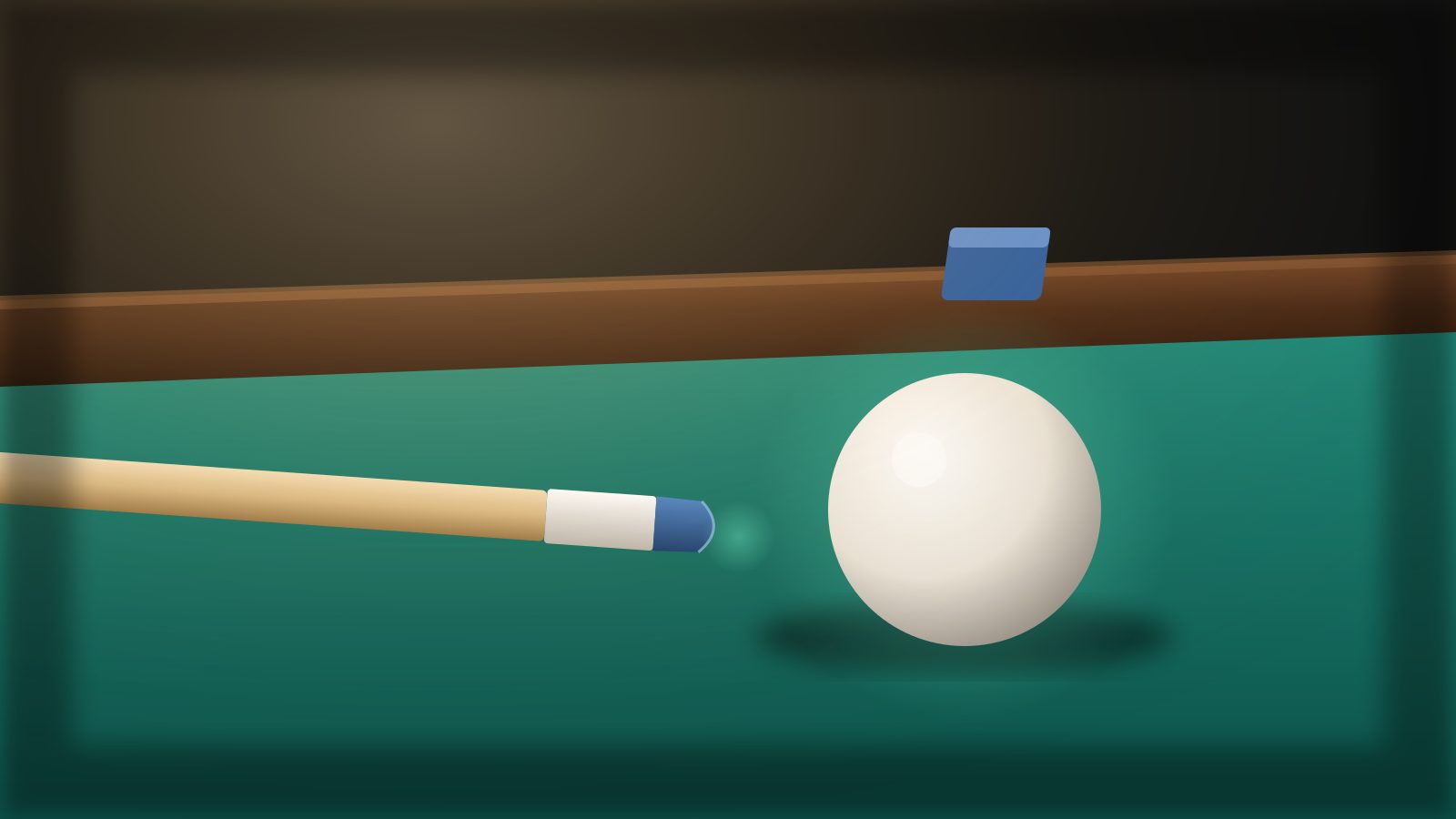
A pool cue tip is the small leather pad glued to the end of your cue, and it is the only part of the cue that ever touches the ball. For most players the right tip is a medium-hardness leather tip, 12 to 13 millimetres wide, shaped to the curve of a nickel or a dime and chalked before every shot that uses spin. Get those four things right and the tip stops being a variable. Get them wrong and no amount of practice will make your draw shot reliable.
01
What the tip actually does
The cue tip has one job: grip the cue ball for the thousandth of a second they are in contact. On a center-ball hit almost any tip will do, because all the force goes straight through the middle. The tip earns its keep on off-center hits. Strike below center and you want the leather to hold the ball long enough to set it spinning backward for a draw shot. Strike to the side and the same grip puts english on it.
When the grip fails, you get a miscue: the tip skids off the ball, the cue ball squirts away weakly, and you usually hear a sharp click instead of the normal thud. Every choice below — hardness, shape, chalk, maintenance — is really a choice about how reliably the tip grips.
02
Soft, medium, or hard
Tips are sold by hardness, usually soft, medium, hard, and sometimes extra hard. The labels are not standardised between manufacturers, so one brand’s medium can feel like another’s hard, but the trade-offs run the same way.
Soft tips compress more on contact, which keeps them on the ball fractionally longer and makes spin feel easy. They also hold chalk well. The cost is durability: soft leather flattens, mushrooms out over the ferrule, and needs trimming and reshaping more often.
Hard tips hold their shape for a long time and give a crisp, solid feel with a little more speed off the cue. They are less forgiving of a poorly chalked or off-center strike, so miscues are a bit more common until your stroke is consistent.
Medium tips sit in between and are what most house cues and production cues ship with. If you do not already have a strong preference, stay there. The honest truth is that the gap between a soft and a hard tip is far smaller than the gap between a well-kept tip and a neglected one.
03
Layered, solid, and phenolic
Most playing-cue tips are leather, in two constructions. A solid tip is a single piece of pressed leather. It is inexpensive and plays well, but leather is a natural material, so two solid tips from the same box can feel different and one may wear unevenly. A layered tip is several thin sheets of leather laminated together. The layering makes it more consistent and slower to lose its shape, which is why it costs more.
A third type, phenolic, is a hard resin rather than leather. It transfers energy very efficiently and barely wears, which suits break and jump cues, but it grips poorly for finesse spin. Keep phenolic on the breaking cue and leather on the one you play with.
The tip is cut to match the ferrule, so you do not really choose its width. Most playing cues are 12 to 13 mm; break cues and house cues often run 13 to 14 mm. A narrower tip feels more precise and produces a little less cue-ball deflection on spin shots, but it also hits a smaller area, so it rewards a straight stroke.
04
Nickel or dime: shaping the dome
A new tip is usually flat on top and must be shaped into a dome before it plays properly. The two common profiles are named after coins. A nickel radius matches the curve of a US nickel and is a little flatter. A dime radius matches a dime and is a little rounder. Hold the coin against the tip side-on and you can see at a glance which one you have.
The rounder dime shape keeps the contact point small and close to where you aim, which helps on spin shots. The nickel shape spreads the contact slightly and some players find it more forgiving. Either is fine. What is not fine is a tip that has worn flat, because a flat face meets the ball at its edge on an off-center hit, and the edge is where miscues start.
Shaping takes a cheap shaper or a strip of fine sandpaper: hold the cue upright and work the abrasive around the tip with light, even strokes, checking against the coin as you go. Take off as little leather as possible. A tip only has a few millimetres to give.
05
How to chalk without wrecking the tip
Chalk is not optional and it is not ceremony. It is a fine abrasive that fills the surface of the leather and gives it something to bite the cue ball with. Even a perfect tip miscues without it, and a single firm draw shot can scrape most of a coat away.
Chalk before every shot that uses spin, and at least every other shot otherwise. Hold the cube at an angle and brush it across the tip in short strokes, rotating the cue so the edges get coated, not just the crown. Then glance at the tip: you want an even, thin layer with no bare patches. Do not drill the tip into the cube with a twisting motion. That carves a pit in the chalk, coats the center and misses the edge, which is exactly where off-center hits make contact.
06
Maintenance and when to replace a tip
Over time the surface of a tip packs down and goes shiny, a state called glazing. A glazed tip refuses to hold chalk. The fix is a light scuff: a scuffer or fine sandpaper roughens the surface again in a few strokes. Do it when you notice the shine, not every session, or you will sand the tip away.
Softer tips also spread sideways under repeated impact, curling over the edge of the ferrule. This is mushrooming, and you can trim the overhang flush with a sharp blade and burnish the side with a bit of leather or paper.
Replace the tip when any of these is true:
- It has worn down to around two millimetres of leather.
- It keeps mushrooming no matter how often you trim it.
- It stays glazed and slick even straight after scuffing.
- Any part of it is lifting away from the ferrule.
- Shots you play routinely have started to miscue.
Replacement is cheap. A billiards shop will usually fit a new tip while you wait, and the leather itself costs anywhere from a few dollars for a solid tip to considerably more for a premium layered one.
07
The miscue limit is real
Even a perfect, freshly chalked tip has a limit. Beyond roughly half a ball radius from the center of the cue ball, the angle between tip and ball becomes too steep for friction to hold, and the tip slides off whatever it is made of. That is why aiming at the very bottom edge of the ball for extra draw does not work. More spin comes from a smooth, accelerating stroke inside that limit, not from reaching further out.
In Duel: 8 Ball Pool, the spin control draws that boundary as a ring on the cue ball, so you can see how far off center is still a reliable contact before you shoot. On a real table you have to feel it, which is one more reason to keep the tip shaped and chalked: it widens the margin you can trust.
08
Common questions
What is the best pool cue tip hardness?
Medium is the best starting point for most players, because it grips well enough for draw and english while keeping its shape for months. Soft tips hold chalk and spin a little more easily but flatten and mushroom faster, while hard tips last longer and give a crisper hit at the cost of slightly more miscues. The difference between them is smaller than the difference a well-shaped, well-chalked tip makes.
How often should you chalk your cue tip?
Chalk before any shot that uses spin, and at least every other shot even on center-ball hits. Chalk is what lets the leather grip the cue ball, and one hard draw shot can strip most of it off. Brush the chalk on with light strokes around the edge of the tip rather than grinding the tip into the cube.
When should you replace a pool cue tip?
Replace the tip when it has worn down to roughly two millimetres, when it has mushroomed over the edge of the ferrule and keeps doing so after trimming, or when it is glazed hard and will not hold chalk even after scuffing. Repeated miscues on shots that used to be routine are often the first sign. A tip that is coming unglued from the ferrule needs replacing immediately.
What is the difference between a layered and a solid cue tip?
A solid tip is cut from a single piece of pressed leather, while a layered tip is several thin sheets of leather glued together. Layered tips tend to be more consistent from one tip to the next and hold their shape longer, and they usually cost more. Solid tips are cheaper and perfectly good, but they vary more and need reshaping more often.
What shape should a pool cue tip be?
Most players use a dome matching the curve of a nickel or a dime. The nickel radius is slightly flatter and the dime radius is slightly rounder, which makes it a little easier to put spin on the ball. A tip that has gone flat on top should be reshaped, because a flat face contacts the cue ball unpredictably on off-center hits.
Why does my cue keep miscuing?
Miscues almost always come from too little chalk, a glazed or flattened tip, or striking too far from the center of the cue ball. Past roughly half a ball radius from center, the tip cannot grip and slides off. Chalk before spin shots, scuff a shiny tip, and keep your tip offset inside that limit.