
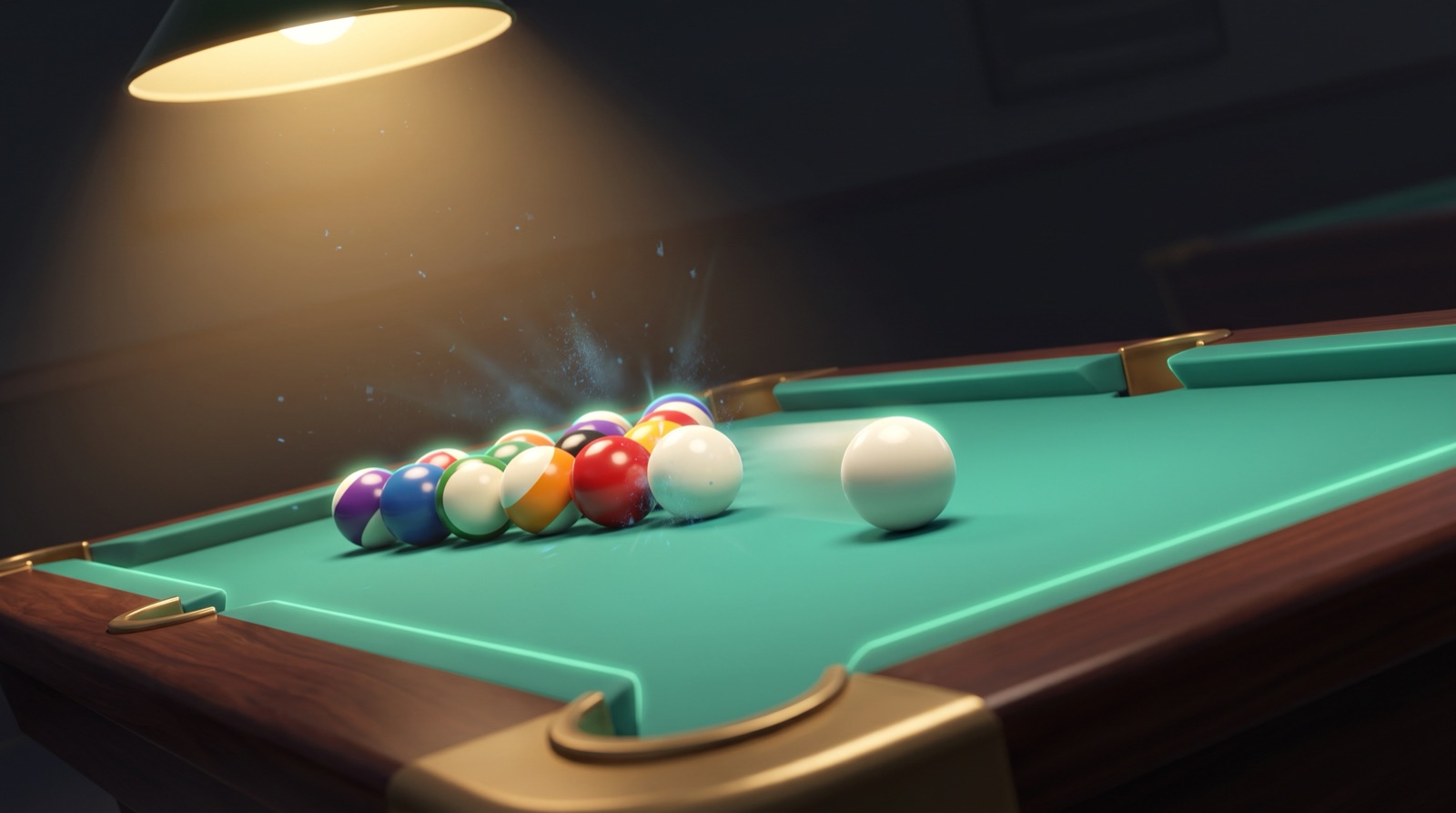
A break in 8-ball is legal if you strike the rack from behind the head string and then do one of two things: pocket at least one object ball, or drive at least four object balls into a cushion. Either condition on its own is enough. Miss both and the break is a foul, and the choice of what happens next belongs to your opponent, not to you.
01
The two conditions, and what counts
The wording matters more than it looks. Four object balls have to reach a cushion — a cue ball travelling three rails after contact contributes nothing. The 8-ball counts as an object ball here, so a break sending the black and three others into rails is legal even if nothing drops.
A ball only needs to touch a cushion, not rebound off it. One edge case: a ball already resting against a cushion counts only if it leaves that cushion and returns to one.
Pocket one, or four to the rails. Cue ball behind the head string. Everything else about the break is detail.
02
Where the cue ball has to start
The break is taken from behind the head string — the line across the table through the second diamond from the head rail, enclosing the region players call the kitchen. You may place the cue ball anywhere in it, a freedom most beginners never use.
Moving six inches off centre changes the angle into the head ball and where the cue ball finishes; plenty of strong players break from near a side rail on purpose. A ball sitting exactly on the head string is not behind it, so give yourself a clear inch.
03
An illegal break hands your opponent the decision
If the break meets neither condition it is a foul, but not the ordinary kind. The incoming player gets three options: play the table as it lies, re-rack and break themselves, or re-rack and make you break again.
That third option is the one people forget, and it is why breaking soft on purpose almost never works. Your opponent looks at the spread, and if it does not suit them they wipe it and start over. A failed break can never be an advantage.
No balls are spotted after an illegal break except the 8, so anything you pocketed stays down if your opponent plays on.
04
Scratching on the break
Putting the cue ball in a pocket on the break is a foul, and the most common way to lose the opening advantage. It does not lose the game, it does not un-pocket the balls you made, and the table stays open — nothing that dropped has assigned you solids or stripes.
The penalty is the part players get wrong. Your opponent gets ball in hand behind the head string, not anywhere, and can only shoot at balls past that line — so a scratched break with the pack still bunched near the foot rail hurts far less than a scratch later in the rack.
05
The 8-ball on the break
The most argued-about outcome in the game has an undramatic official answer: neither a win nor a loss. The breaker chooses between having the 8 spotted on the foot spot and continuing, or asking for a re-rack and breaking again. If the cue ball also scratched, the 8 is spotted and the incoming player takes ball in hand behind the head string.
Bar and house rules very often make an 8 on the break an instant win, sometimes with the caveat that a simultaneous scratch loses. Neither version appears in the published rules of the World Pool-Billiard Association or the Billiard Congress of America. Settle it before the first rack, not during it.
06
How to make the break legal every time
Four balls to the rails sounds demanding and is not. A square, reasonably firm hit on the apex ball of a tight rack sends far more than four into cushions. Illegal breaks come from two causes: a thin, glancing contact on the head ball, or a gapped rack that swallows the energy instead of passing it on.
So check the rack — you are entitled to ask for it to be tightened — and strike the head ball as fully as you can. Accuracy beats speed: a controlled three-quarter-pace break spreads a rack better than a wild swing that catches the apex at an angle.
Use a level cue and centre-ball contact, or a touch below. Top spin is the fastest route to following the cue ball into the pack and then into a pocket.
A gapped rack absorbs the shot. Tighten it, hit the head ball square, and the four-cushion requirement takes care of itself.
07
Why the rule exists at all
Every part of the rule aims at one problem: stopping the opening shot from becoming a stalling tactic. Without a minimum spread, the strongest opening in 8-ball would be a gentle tap leaving the rack intact and the opponent nothing to shoot at.
It is also why a simulator has to model the break rather than script a pleasing scatter. In Duel, a break that fails to move four object balls to a cushion is flagged as illegal and the incoming player is offered the re-rack, and a break scratch restricts them to the kitchen rather than handing over the whole table.
08
Common questions
What makes a break legal in 8-ball?
A break is legal if the cue ball strikes the rack and the breaker either pockets at least one object ball or drives at least four object balls to a cushion. Only one of those two conditions has to be met, not both. The cue ball hitting a cushion does not count toward the four, and the shot must be taken with the cue ball behind the head string.
What happens if you don’t hit four balls to the rail on the break?
It is an illegal break, and the incoming player chooses what happens next. They can accept the table as it lies and shoot, or have the balls re-racked and break themselves, or re-rack and make the original breaker break again. Because the choice belongs to the opponent, a soft break is rarely a useful tactic — you hand them a spread table or a fresh rack, whichever suits them.
Do you have to hit the head ball on the break?
Standard 8-ball rules do not require you to strike the apex ball specifically — you only need to make legal contact with the rack and meet the four-balls-to-a-cushion or one-ball-pocketed condition. Hitting the head ball as fully as possible is still the practical way to do it, because a full hit spreads energy through the whole rack. Some leagues and house rules do add a head-ball requirement, so it is worth asking in an unfamiliar room.
Where do you place the cue ball for the break in 8-ball?
Anywhere behind the head string, which is the imaginary line across the table through the second diamond from the head rail — the area commonly called the kitchen. You are not limited to the middle, and moving a few inches off center is a legitimate way to change the angle into the rack. A ball resting exactly on the head string is not behind it, so keep the cue ball clearly inside the area.
What happens if you scratch on the break in 8-ball?
Scratching on the break is a foul, but it does not lose the game. Balls pocketed on that break stay down, the table stays open, and the incoming player takes ball in hand behind the head string rather than anywhere on the table. That restriction is specific to the break — later scratches in most rulesets give ball in hand anywhere.
What happens if you pot the 8-ball on the break?
Under official rules it is neither a win nor a loss: the breaker may either have the 8-ball spotted and carry on shooting, or ask for a re-rack and break again. If the 8 goes down and the cue ball scratches on the same shot, the 8 is still spotted and the incoming player takes ball in hand behind the head string. Many bar and house rules treat an 8 on the break as an instant win, which is a local convention rather than a published rule.