
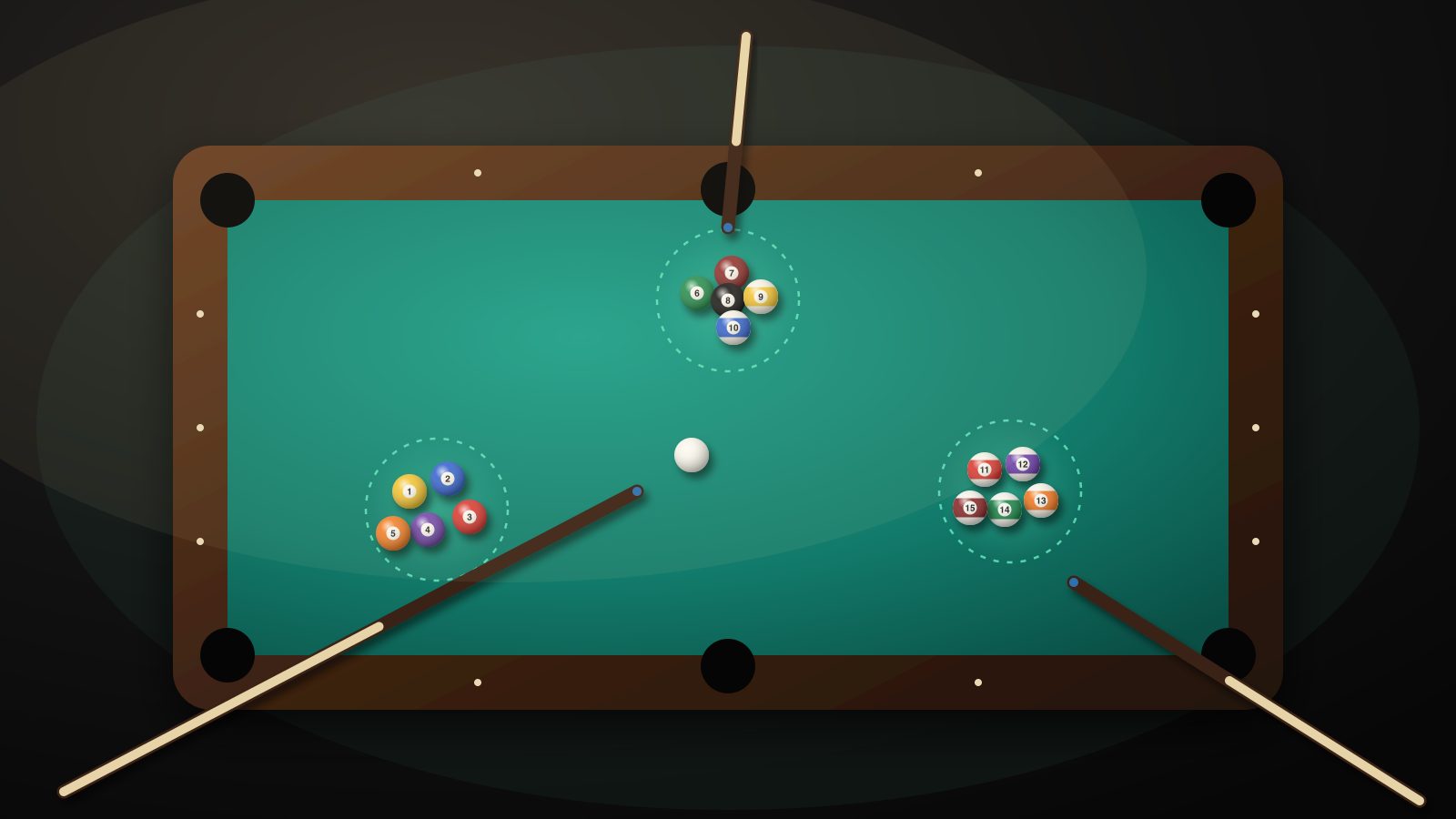
Cutthroat is pool for three players. Each player owns five balls — the 1 to 5, the 6 to 10, or the 11 to 15 — and the goal is backwards from every other pool game: you pocket your opponents’ balls, not your own. When all five of a player’s balls are down, they are out. The last player with a ball still on the table wins.
01
What you need and how to rack
A standard table, a full set of fifteen numbered balls and the cue ball, and exactly three players. The 8-ball has no special status; it is just one of the middle group.
Rack all fifteen in the usual triangle with the apex ball on the foot spot. Put the 1 at the apex, the 6 on one back corner and the 11 on the other. That gives every group one ball in a corner position, where breaks tend to send balls toward pockets. Fill the rest randomly, and avoid leaving any group bunched together, since a clump of one player’s balls is a gift to whoever breaks.
Decide the shooting order before the break — lag, flip, or agree — and keep it fixed. Order matters more in cutthroat than in any two-player game, because every shot you play leaves the table for one specific opponent.
02
The break and claiming groups
The first player breaks. Most groups use the same standard as 8-ball: the breaker must pocket a ball or drive at least four balls to a cushion, or the next player can ask for a re-rack. A scratch on the break is a foul and the next player shoots with ball in hand behind the head string.
How groups are handed out is the rule people most often disagree on, so settle it first. There are two common ways:
Open table. The table stays open after the break. The first player to legally pocket a ball claims a group, usually the group that ball came from. The next player to pocket a ball from a different group claims that one, and whoever is left takes the third. This is the version most leagues and rule books describe.
Assigned groups. Groups are fixed before the break by shooting order: first shooter low, second middle, third high. It is simpler, removes arguments, and is common in casual play.
Under open-table rules, any ball that drops before groups are claimed stays down. If you claim a group that already lost two balls on the break, you start with three. That is why players often claim the group that has suffered least.
03
Taking a turn
You may hit any object ball first. There is no wrong-ball foul, which is the biggest single difference from 8-ball. After contact a ball must be pocketed or some ball must reach a cushion, the same no-rail rule as other games.
Your turn continues as long as you legally pocket a ball. In most rule sets that includes pocketing one of your own, which keeps you at the table but costs you a life. Most of the time you are shooting at an opponent’s ball, and every one you sink pushes that player closer to elimination.
When all five balls in a player’s group are down, that player is out and play passes over them. The game continues between the two who remain until one of them is cleared, and the last player with anything left on the table wins.
04
Fouls and the ball-return penalty
The usual fouls apply: scratching, knocking the cue ball off the table, missing every ball, or failing to reach a cushion after contact. Your turn ends and the next player shoots, usually with ball in hand.
The penalty that makes cutthroat different is the ball return. In most rule sets, each opponent who has balls in the pockets gets one of them spotted back on the table — on the foot spot, or as close behind it as possible. One foul hands a ball back to both rivals. Some house rules also let an eliminated player back into the game if a foul returns one of their balls, which is worth agreeing on before the first rack.
In 8-ball a foul gives one opponent a better position. In cutthroat it gives two opponents a life each. The cue-ball discipline that stops scratches matters even more here.
05
Strategy that actually wins cutthroat
Target the leader. The player with the most balls left is the one who wins if nothing changes. Spread your shots so the other two players stay level with each other, and let them knock each other down while you are still in front. Opponents who understand this will do the same to you, which is why a big early lead often vanishes.
Think about who shoots next. When you miss or play safe, the table goes to one particular player. Leave them an easy shot at the third player’s balls, not yours. A position that is a disaster for you in 8-ball — leaving the next shooter an open table — can be perfect in cutthroat if every open ball belongs to someone else.
Hide your own balls, don’t pocket them. Balls frozen to a cushion, tucked behind other balls, or sitting far from any pocket are hard to make. Nudging your own balls into those spots during a turn is often worth more than potting an extra ball for an opponent.
Play position, not just shots. Because you can hit any ball, you almost always have something to shoot at. The real skill is choosing the shot that leaves the cue ball on the next opponent ball, so you can stay at the table and run several in a row. That is the same cue-ball control you would use in 8-ball, and it transfers directly.
Duel is an 8-ball game and does not include cutthroat, but its practice mode is a reasonable place to drill that control: the physics runs on a fixed time step, so the same aim, power, and spin always send the cue ball to the same place.
06
Variations you will run into
Five players. The fifteen balls split into five groups of three: 1 to 3, 4 to 6, and so on. Everything else is the same, but games are shorter and shooting order matters even more.
Call your shots. Some groups play called-shot cutthroat to cut down on lucky slop. A ball that drops without being called stays down, but your turn ends.
No ball return. In the simplest bar version, a foul only passes the turn with ball in hand and nothing is spotted. It plays faster and punishes mistakes far less.
None of these is the “real” rule. Cutthroat has never had a single governing rule book the way 8-ball and 9-ball do, so the only correct version is the one everyone agreed to before the break.
07
Common questions
How do you play cutthroat pool?
Cutthroat is played by three players with all fifteen object balls. Each player owns a group of five: 1 to 5, 6 to 10, or 11 to 15. You try to pocket your opponents’ balls while protecting your own, a player is out when all five of their balls are down, and the last player with a ball on the table wins.
How do you rack for cutthroat pool?
Rack all fifteen balls in a standard triangle with the apex ball on the foot spot. Put the 1 at the apex, the 6 on one back corner and the 11 on the other, so every group starts with a ball in a corner. Mix the remaining balls randomly so no group sits together.
How are groups picked in cutthroat?
Under the most common rule the table stays open after the break, and the first player to legally pocket a ball claims a group, usually the group that ball belongs to. The next player to pocket a ball from a different group claims that one, and the last player gets what is left. Some players simply assign groups by shooting order before the break, so agree on which method you are using first.
What is the penalty for a foul in cutthroat?
Your turn ends and, in most rule sets, each opponent gets one of their pocketed balls spotted back on the table. The next player then shoots, usually with ball in hand. Because the penalty gives balls back to your rivals, a single scratch can undo several good turns.
Can you play cutthroat pool with 2 or 4 players?
Not as written. Cutthroat needs the fifteen balls to split evenly, so it works with three players at five balls each or five players at three balls each. Two players should play 8-ball, and four players usually play 8-ball as two teams.
Do you have to hit your own ball first in cutthroat?
No. In cutthroat you may hit any object ball first, so there is no wrong-ball foul like in 8-ball. You still have to make contact with a ball, and after contact a ball must be pocketed or some ball must reach a cushion, or it is a foul.