
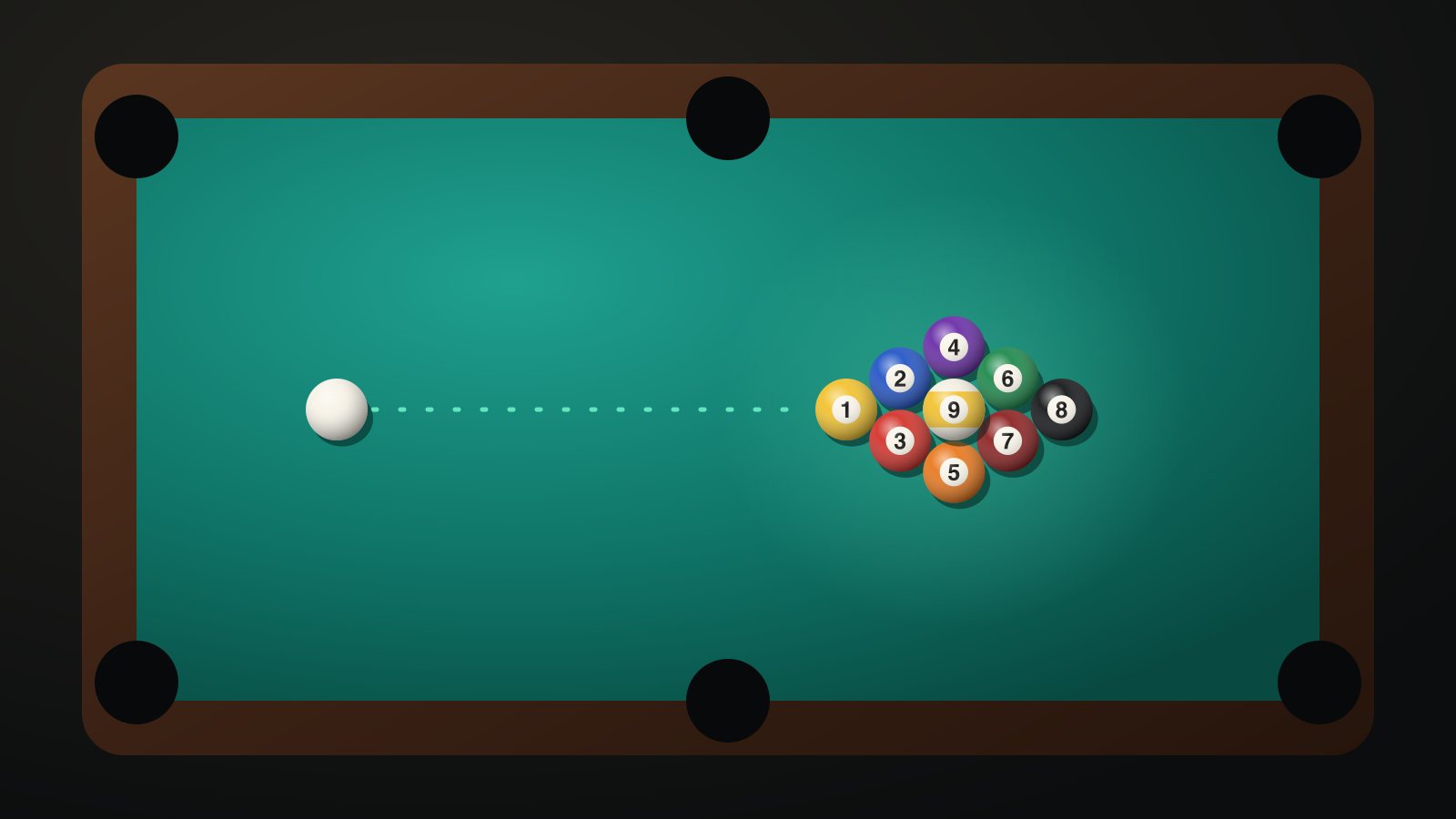
In 9-ball, the cue ball must hit the lowest-numbered ball on the table first, and whoever legally pockets the 9 wins. That is nearly the whole game. You do not own a group, you do not call your shots, and you do not have to clear the table: hit the 1 into the 9 on your first shot and the rack is over. The rest of the rules exist to settle the break, the fouls, and one odd shot called the push out.
01
The rack
Use the nine balls numbered 1 to 9 and rack them in a diamond. The 1-ball goes at the front, sitting on the foot spot. The 9-ball goes in the exact centre. The other seven go anywhere, and most rule books want them placed at random. Rack as tightly as you can, because gaps kill the break.
A diamond-shaped rack makes this easy, and a thin rack template works too. For the full method, see how to rack pool balls.
02
The break
The breaker places the cue ball anywhere behind the head string and must hit the 1-ball first. Under World Pool-Billiard Association rules, the break is legal only if a ball is pocketed or at least four object balls reach a rail. Fail either test and it is a foul, with the opponent taking ball in hand anywhere on the table.
Balls pocketed on a legal break stay down and the breaker keeps shooting. A 9 made on the break is spotted, not a win. This is the rule most often changed in casual play, because many bar games and leagues treat it as a win on the spot.
03
The push out, and why it exists
On the first shot after a legal break, the player about to shoot, whether that is the breaker or the opponent, may announce a push out. For that one shot the cue ball does not have to hit the lowest ball, and no ball has to reach a rail. All other fouls still apply, so a scratch remains a scratch.
The catch is that your opponent then chooses: shoot from where you left things, or hand the shot back to you. So a good push out leaves a position that looks equally unpleasant to both of you, which is harder than it sounds. The rule exists because the break can leave the cue ball with no possible hit on the 1, and luck should not decide the rack from there. A 9 pocketed on a push out is spotted, and anything else pocketed stays down.
A push out only counts if you say so before you shoot. If you stay silent, the normal rules apply and a shot that misses the 1 is a foul.
04
A legal shot, every turn
After the opening, every shot has two requirements. The cue ball must contact the lowest-numbered ball on the table first. Then a ball must be pocketed, or the cue ball or an object ball must reach a rail.
Once the first contact is legal, anything that drops counts. Hit the 3, send it into the 7, and pocket the 7, and you shoot again at the 3. Hit the 3 into the 9 and you have won. No ball needs calling and luck is allowed, which is why experienced players treat a loose 9 near a pocket as a threat from the very first shot.
Safeties are legal and common. Because nothing is called, a ball that drops by accident keeps you at the table, whether you wanted that or not.
05
Fouls and ball in hand
The common fouls are these:
- The cue ball is pocketed or leaves the table.
- The cue ball hits a higher-numbered ball first, or nothing.
- No ball is pocketed and no ball reaches a rail after contact.
- An object ball leaves the table.
- You touch a ball, double-hit the cue ball, or shoot with no foot on the floor.
The penalty is always the same: your opponent gets ball in hand anywhere on the table. In a game where one good shot can end the rack, that is severe. With the 9 near a pocket, ball in hand often means an easy combination and the game.
Object balls pocketed on a foul stay down, and so do balls knocked off the table. The 9 is the exception, and it always comes back to the foot spot if it drops on a foul or leaves the table. A 9 pocketed on a foul therefore never wins.
06
Three fouls and stalemates
Three consecutive fouls in one game by the same player loses that game. The opponent has to warn you after the second, and without that warning the third does not count. Our three-foul rule guide covers how to use the threat.
If both players keep trading safeties and neither is making progress, the referee can declare a stalemate after a warning. The rack is then replayed, and whoever broke that game breaks again.
07
Bar rules and league rules
Everything above follows the World Pool-Billiard Association rule book. Local games often change a few details, so settle these before you start:
The 9 on the break. Spotted under the rule book, a win in many bars and in the APA.
The push out. Skipped entirely in many casual games. If it is not agreed, assume it is off.
Ball in hand. Some bar tables only give the player behind the head string, or play that a foul simply passes the turn.
Scoring. Matches are usually a race to a set number of racks. APA league play scores differently, with one point per ball and two for the 9, and a player’s handicap sets how many points they need to win.
08
Why the rules change how you play
Forcing the lowest ball first means you never get to choose an easy target, only the next one. So 9-ball rewards cue ball control more than almost any other skill. Finish with an angle on your next ball, and do it from the shortest route that keeps the cue ball away from the other balls.
The rules also make safeties extremely strong, because an opponent who cannot find the lowest ball will often foul and hand you ball in hand. And they make combinations worth checking every time: before each shot, look at whether the lowest ball can go through to the 9.
Duel is an 8-ball game and does not include 9-ball, but its practice mode is a reasonable place to drill that kind of position play: the physics runs on a fixed time step, so the same aim, power, and spin always send the cue ball to the same place. For the 8-ball version of this guide, read how to play 8-ball.
09
Common questions
What are the basic rules of 9 ball?
9-ball uses nine object balls and the cue ball. On every shot the cue ball must hit the lowest-numbered ball on the table first, and after that contact a ball must be pocketed or some ball must reach a rail. You keep shooting as long as you pocket a ball on a legal shot, and you win by legally pocketing the 9.
Do you have to call your shots in 9 ball?
No. Standard 9-ball is not a call-shot game, so any ball that drops on a legal shot counts and you keep shooting. That includes the 9, even if you did not mean to pocket it. 10-ball is the close relative that does require you to call your shots.
What happens if you make the 9 ball on the break?
Under World Pool-Billiard Association rules, a 9 made on a legal break is spotted and the breaker keeps shooting. Many leagues and bar games, including the APA, count it as an instant win instead, so agree on this before the first rack. If the break was also a foul, the 9 is spotted and the opponent gets ball in hand.
What is a push out in 9 ball?
A push out is a special shot available only to the player shooting immediately after a legal break. You announce it, and the cue ball no longer has to hit the lowest ball or any rail. Your opponent then chooses whether to shoot from the new position or make you shoot from it.
What is the penalty for a foul in 9 ball?
Your opponent gets ball in hand and may place the cue ball anywhere on the table. Any object balls pocketed on the foul stay down, except the 9, which is spotted. Three fouls in a row in the same game loses that game, provided the player was warned after the second.
How is 9 ball different from 8 ball?
8-ball gives each player a group of solids or stripes to clear before pocketing the 8. 9-ball has no groups: both players always aim at the same target, the lowest ball on the table, and a legal 9 wins at any moment. A rack of 9-ball is shorter and a single combination on the 9 can end it early.